ACT I
Origins & Curiosity
Curious from the beginning
I was raised by a single mother. When I was three, we moved in with my British Nana in Burlington, Ontario, and she became part of raising me too.
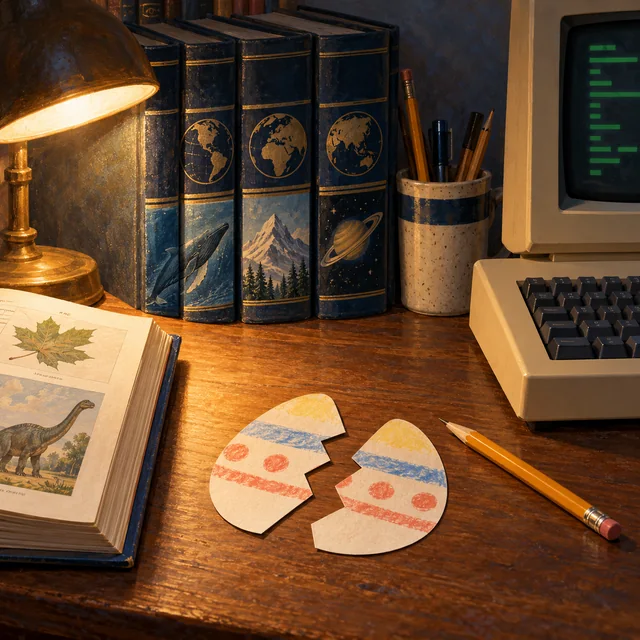
I was always inquisitive. Science, science fiction, puzzles, how things worked—I wanted more of all of it. I read encyclopedias, collected nerdy books, flipped through National Geographic and became engrossed in Reader’s Digest in doctors’ waiting rooms. Before the Internet put almost every answer within reach, I was happily disappearing into whatever information I could find.
James Burke’s Connections was exactly my kind of television. Here were discoveries, inventions and seemingly unrelated events joining together into something bigger. I wish there were more programs like it.
There was gentler television too: Mister Dressup, The Friendly Giant, Reading Rainbow, Romper Room. I still have affection for that kindness and curiosity. Children deserve room to be children, without every moment competing for their attention.
There was also the Sears catalogue—but that’s a different chapter of eighties nostalgia.
My mum and I watched Star Trek religiously. Science fiction gave me possibilities to think about, worlds to explore and characters I would carry with me for reasons I didn’t fully understand at the time.
Finding another way
Math and science generally came easily to me. Languages were harder. But even in the subjects I struggled with, I looked for another way into the problem.
In a primary-school French activity, we had to match words printed on paper eggs that had been cut into two pieces. I noticed that the cuts were distinctive. I could match the edges instead of working out the words.
It seemed obvious to me. What surprised me was how surprised everyone else was when I explained it.
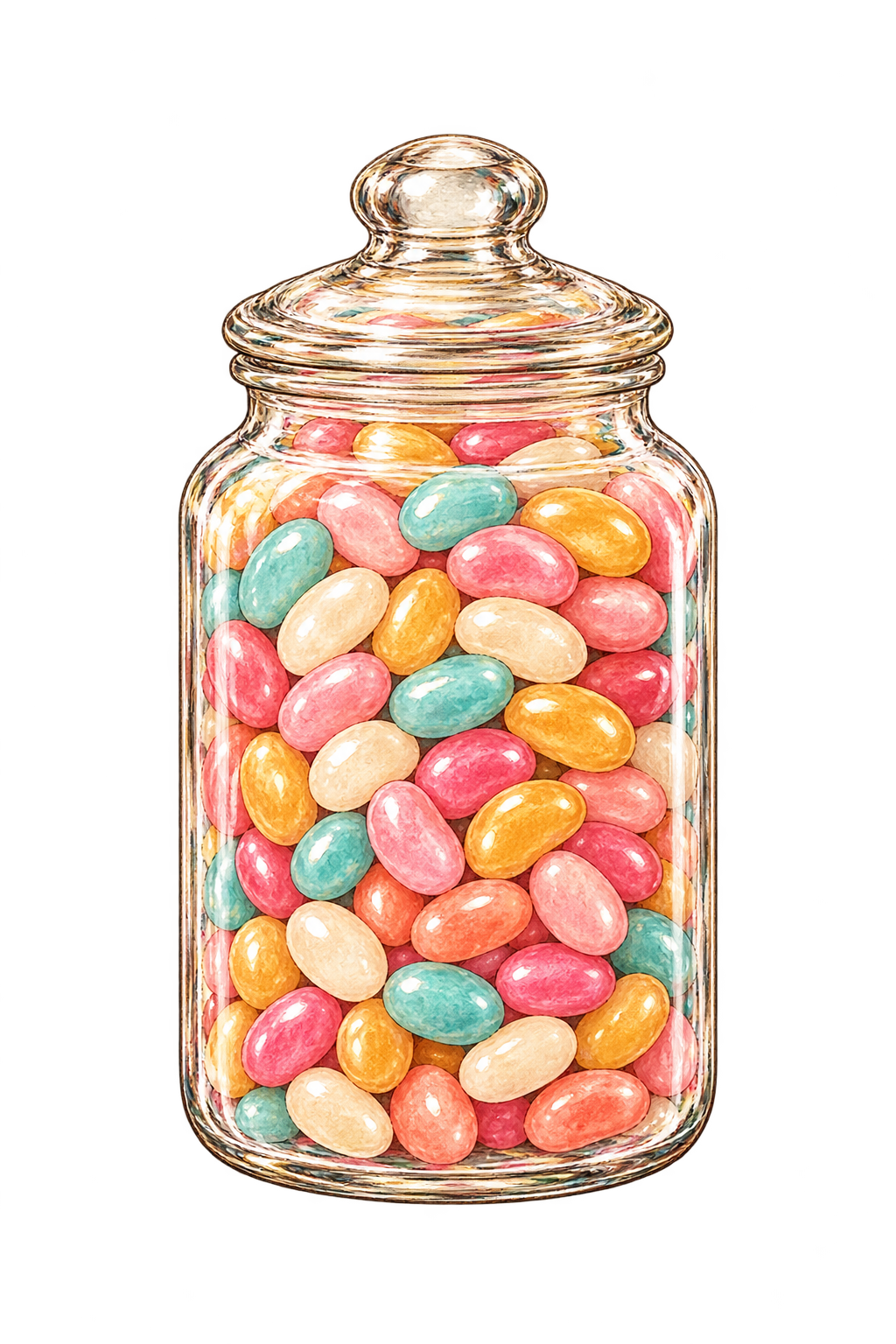
Another time, we had to guess how many jelly beans were in a large jar. I didn’t want to guess randomly. I counted what I could see, estimated the layers and worked out a rough total.
I won the jelly beans. I don’t remember the exact number or how close I was, but I remember the teacher’s reaction—and glowing red with pride.
Those are small memories, but they capture something familiar: noticing information other people weren’t using, making a model of the problem, and finding a way through.
Learning to hide
Understanding schoolwork was often much easier than understanding the people around me.
My mum was a teacher, and I transferred to her school in Grade Four, although she never taught me. I had some kind friends. I went to birthday parties. I wanted to belong. But I frequently didn’t know what to say, when to speak or how to join in.
I wanted to share ideas. What I would now call info-dumping was already there: the excitement of discovering something and wanting someone else to see it too.
There was bullying, nervousness and a lot of self-consciousness. Afterward, I would replay conversations and pull myself apart over something I’d said. Why had I said that? Why hadn’t I known what to do?
My mum loved and praised me. That existed alongside the feeling that, elsewhere, I was getting something fundamental wrong.
So I learned to hide. I pretended not to know things. I slowed myself down. I suppressed ideas and excitement because I thought that might make me easier to accept.
I also decided that perhaps I could protect myself by not showing emotion.
I wanted to be like Data. Like Spock. Logical. Composed. Untouchable.
I wasn’t without feelings. I was trying to put them somewhere nobody could hurt them.
“Find the good in people”
That was my Nana’s advice, and it has stayed with me.
Even when someone hadn’t been particularly kind to me, if they needed help, I usually wanted to give it. I volunteered. I tutored. I worked as a teaching assistant. I loved helping someone understand math, science or computers.
I still do. There is enormous satisfaction in finding an explanation that finally makes something click for another person.
At school, I also helped get computers reimaged with Norton Ghost and back onto the network. Computers made sense to me. There were instructions, relationships and reasons. If something went wrong, there was something to investigate.
People were harder to follow.
We’re all defective meat machines, as I sometimes put it. Myself very much included.
I’ve given away time, belongings and money because someone needed something or a cause mattered to me. That generosity is real. So is the difficulty I’ve had knowing when to stop giving.
Finding the good in people has not always protected me from being hurt by them.
ACT II
The Developer & The Craft
What “full stack” means to me
Technically, I’m a full-stack developer: database, business logic, front end and the connections between them.
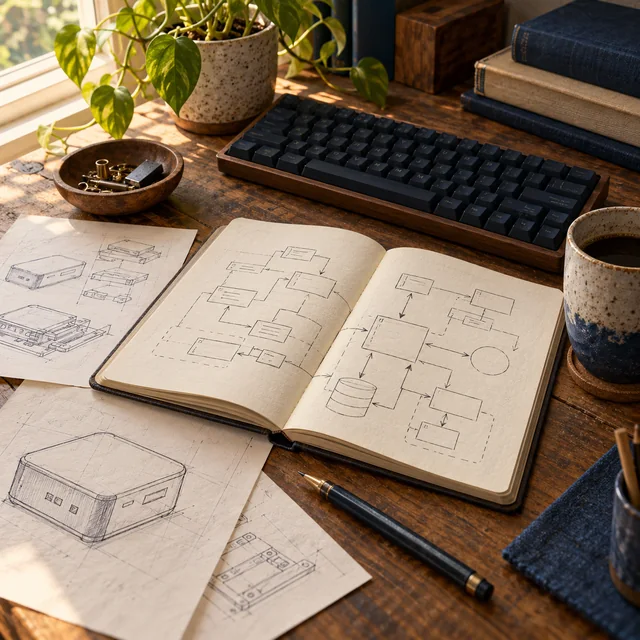
But for me, full stack means more than technical coverage. It means the whole life of a product.
The first idea. Understanding what it solves and who it helps. Defining its behaviour. Designing it, implementing it, testing it, fixing it, expanding it and keeping it alive.
It means knowing it like the back of my hand—holding the parts and their relationships together in my mind. And having a passion for it, beyond the satisfaction of getting something built.
I want to understand the idea before breaking it into features. What should the experience be? What information does it need? How does it connect to what already exists? Where will it become difficult to maintain? What might it need to become later?
Sometimes the best answer is a new feature. Sometimes it is a better tool, an integration or a change to the original idea.
I’m especially interested in recurring problems. If people repeatedly need help with the same thing, I want to understand why—and build something that lets them solve it themselves.
Ownership, standards and working with others
I often prefer working alone, with clear ownership and uninterrupted time to think. After many years as a largely solo developer, that way of working is familiar to me.
That doesn’t mean I don’t enjoy people. I love teaching, sharing ideas and helping someone understand a system. But I value the space to follow a problem deeply and take responsibility for the result.
I’m also demanding about quality.
I’ve worked with specifications and user stories that fell substantially below the standard I expect of professional software development: incomplete explanations, disconnected requirements and basic questions left unanswered. That leaves the person implementing the work to reconstruct thinking that should already have happened.
I don’t consider that good enough. Those are standards I hold myself to as well.
That can create friction. I can be direct, and when a connection or an important problem occurs to me, I sometimes speak before someone else has finished. I try not to interrupt, but I don’t always manage it.
I want collaborators who care about the work, challenge ideas thoughtfully and contribute strengths of their own. I want us to move quickly because we understand what we’re building—not because we’ve skipped the difficult thinking.
Loyalty—and staying
I’ve only had two jobs.
The first came through my computer-science co-op at the University of Toronto. I found the opportunity quickly and stayed—perhaps longer than I should have. My next employer recruited me away.
I’ve never really had to navigate a conventional job search, which makes the prospect of doing it now daunting.
Change is difficult for me. Understanding my autism has helped me make sense of that. But staying was also about loyalty. I became invested in the company, the product and the people relying on it. I wanted to help build something that lasted.
For years, that meant long hours, difficult work and being conscious of the constraints of a small company. When the business grew, I wanted capable people alongside me—a developer, a designer, support that would let us build more.
I assumed that commitment and contribution would be recognized fairly. I wasn’t continually looking elsewhere for the next salary increase. I was putting my effort into the place I already cared about.
That loyalty has been a strength. It has also left me vulnerable to staying in circumstances that were hurting me.
ACT III
The Human Side
An unlocked CPU
At forty-five, my first burnout began a slow realization that changed how I understood my life.

I’m autistic and have ADHD—AuDHD. I also identify as twice-exceptional: significant strengths and real difficulties existing in the same person. I recognize parts of myself in INTJ and Enneagram descriptions too. Those frameworks don’t explain everything, but they have given me ways to reflect on patterns I’d struggled to understand.
There have now been two burnouts. This second one has been harder.
I haven’t been able to mask in the way I once did. And alongside the distress, I’ve experienced a freedom in my thinking that is difficult to explain without reaching for a computer metaphor.
For much of my life, I felt underclocked and undervolted. I was deliberately holding myself back, while the background process of masking consumed resources of its own.
Now, when I’m creating, it can feel as though the CPU is unlocked and massively overclocked: voltage up, running hot—but stable.
My mind has room to move.
That doesn’t make the rest easy. I can spend hours absorbed in product ideas, design and detailed specifications, then shake or cry over something painful in my life. Being capable in one area doesn’t make every other area manageable.
Being apart from my daughter is particularly painful. I miss her, and I struggle with feeling that I’ve failed her. Those feelings sit alongside everything I can build. Accomplishment doesn’t simply make them disappear.
Being understood
Then there is Joely.
 Visit our site
With her, I’ve felt understood in a way I hadn’t before. I can be excited. I can info-dump. I can show her something I’ve made and share why it matters to me, even when programming isn’t her world.
That has meant an extraordinary amount.
I’ve never really believed in God. Yet meeting someone who feels so much like my soulmate has made me wonder whether there might be something beyond what I thought I understood. I don’t have a tidy conclusion about that. It is simply something I genuinely feel.
OUR SONG
Chaos and Calm
A little piece of our story, in music.
Press play and the words will follow along
Come meet us and read more of our story
What I want to build now
I want to make useful things, teach people, solve problems and contribute to a fairer world.
I also want to put my name to something that is recognizably mine: work I can show people, stand behind and feel proud of.
I’m not interested in pretending that everything is fine, or presenting myself as a collection of achievements without the person underneath them. I’m still curious. Still meticulous. Still hurt by some things. Still capable of getting ridiculously excited about an idea.
And I still want to be a good person.
I’m not willing to keep making myself smaller to prove it.
I still believe in finding the good in people. I’m trying to build a life that leaves room for me, too.